How to Read the NDC Number to Confirm the Correct Medication
Every time a pharmacist hands you a pill bottle, a nurse prepares an injection, or a doctor writes a prescription, there’s a hidden number on the label that could mean the difference between life and death. That number is the NDC-National Drug Code. It’s not just a barcode or a random string of digits. It’s the unique fingerprint of your medication. Get it wrong, and you could get the wrong drug, the wrong dose, or even a completely different medicine. In the U.S., over 12% of medication dispensing errors trace back to misreading the NDC. But if you know how to read it, you can stop those errors before they happen.
What Exactly Is an NDC Number?
The NDC is a 10-digit number printed on every prescription and over-the-counter medicine sold in the United States. It’s not made up by the pharmacy or the manufacturer-it’s assigned by the FDA. Every drug product, no matter how common, has its own unique code. That means two different strengths of the same drug, like 10mg and 20mg of fluoxetine, have completely different NDCs. Even the same drug in a bottle of 30 pills versus 100 pills gets a different code. The NDC breaks down into three parts, each with a specific job:- Labeler Code (first segment): Who made or packaged the drug. This is a 4-, 5-, or 6-digit number assigned by the FDA to the company-like Pfizer, Teva, or a local pharmacy that repacks pills.
- Product Code (second segment): What the drug is. This 3- or 4-digit number tells you the active ingredient, strength, and dosage form. For example, 3105 might mean 10mg capsules, while 4465 means 20mg capsules.
- Package Code (third segment): How it’s packaged. This 1- or 2-digit number tells you the size and type of container-like 01 for a 30-pill bottle, or 02 for a 100-pill bottle.
On the label, you’ll see it written like this: 00002-3105-01. But here’s the catch-this format isn’t always the same. The FDA allows three possible layouts: 4-4-2, 5-3-2, or 5-4-1. That means the hyphens can fall in different places. You can’t assume the format. You have to count the digits.
How to Read the NDC Step by Step
Verifying an NDC isn’t guesswork. It’s a process. Here’s how to do it right:- Find the NDC on the packaging. Look on the side of the bottle, the blister pack, or the box. It’s usually printed clearly, sometimes in a red circle as shown in FDA training materials. Don’t rely on the pharmacy label alone-always check the original manufacturer’s packaging.
- Count the digits between hyphens. This tells you the format. If it’s 4 digits, then 4 digits, then 2 digits (like 1234-5678-90), it’s a 4-4-2 format. If it’s 5 digits, 3 digits, 2 digits (like 12345-678-90), it’s 5-3-2. If it’s 5 digits, 4 digits, 1 digit (like 12345-6789-0), it’s 5-4-1.
- Compare each segment to the prescription. The labeler code should match the expected manufacturer. The product code must match the drug name, strength, and form-like 10mg tablet, not 20mg capsule. The package code should match the quantity ordered. If the script says 30 pills, the package code should reflect that.
- Check the FDA’s NDC Directory. Go to the FDA’s website and search the 10-digit NDC. You’ll see the official drug name, manufacturer, strength, and approved uses. If the directory says the product is discontinued or doesn’t match the label, stop. Don’t dispense it.
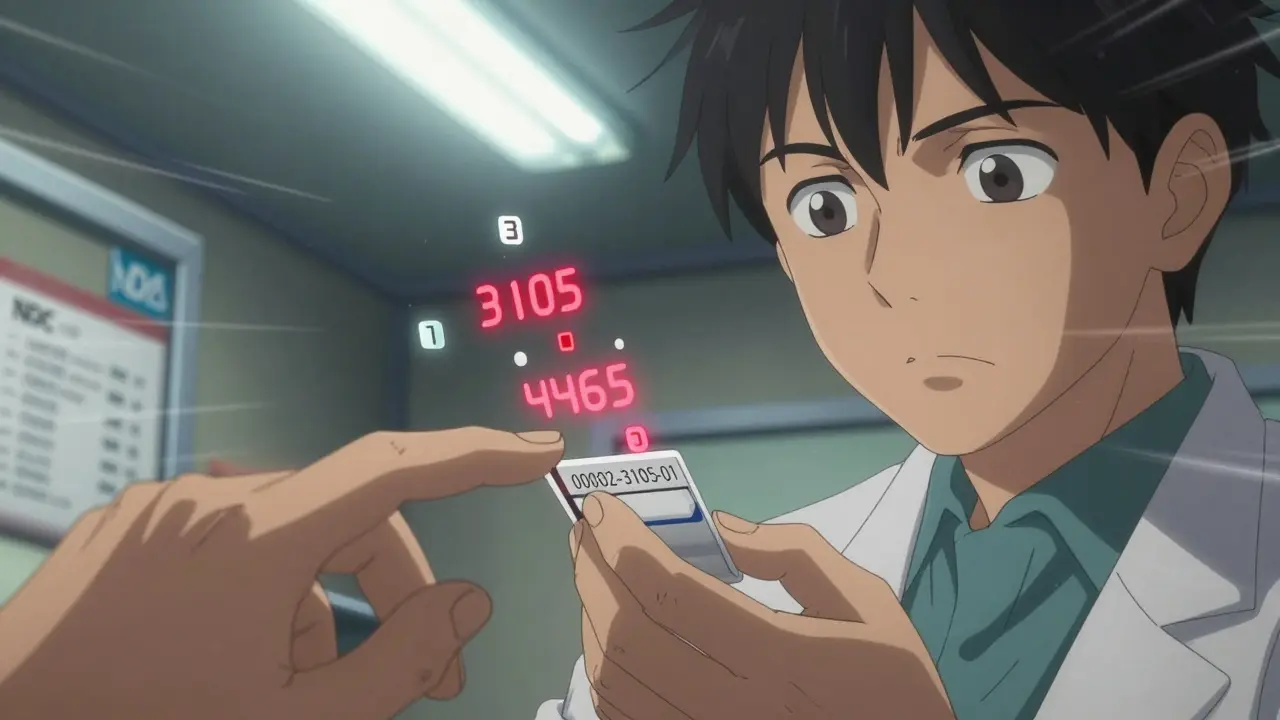
One pharmacist in Arizona caught a fatal error when the NDC on the shelf read 00002-4465-01 (Prozac 20mg capsules), but the prescription was for 00002-3105-01 (Prozac 10mg capsules). The product code was the only difference-but that difference meant doubling the dose. The patient was at risk of serotonin syndrome. She caught it because she checked every digit.
Why the 11-Digit Format Matters
Here’s where things get tricky. While the label shows a 10-digit NDC, insurance systems, Medicare, and Medicaid require an 11-digit version for billing. That’s not a mistake-it’s a requirement. The 11-digit format is always 5-4-2. So if your label says 5-3-2 (like 12345-678-90), you have to add a zero to make it 12345-0678-90. If it’s 4-4-2 (like 1234-5678-90), you add a zero at the front: 01234-5678-90. If it’s 5-4-1 (like 12345-6789-0), you add a zero at the end: 12345-6789-00.Getting this wrong means your claim gets rejected. Patients can’t get their meds. Pharmacies lose money. But more importantly, if you’re mixing up the 10-digit and 11-digit versions in your head, you might misread the product code. That’s how errors creep in.
A hospital tech in Oregon told Reddit he spends 15-20 minutes extra per shift just converting NDCs. He’s not alone. Over 60% of pharmacists report NDC format confusion at least once a month. The fix? Train your team. Use a conversion chart. Keep a printed reference near the counter. And never assume-always count.
Common Mistakes and How to Avoid Them
Even experienced staff slip up. Here are the top three errors-and how to stop them:- Mixing up product code and package code. The product code tells you what the drug is. The package code tells you how many pills. If you see 00002-3105-01 and think 3105 is the quantity, you’re wrong. 3105 is the strength and form. 01 is the bottle size. Always verify the segment position.
- Assuming the same drug has the same NDC. If you refill a prescription and the bottle looks different, don’t assume it’s the same. Generic drugs from different manufacturers have different NDCs. Even the same manufacturer might change packaging. Always check the NDC, not the label design.
- Not verifying discontinued codes. In just nine months in 2023, the FDA deactivated over 8,500 NDCs. Some were recalled. Others were discontinued. If the NDC isn’t in the FDA’s current directory, it’s not approved. Don’t dispense it.
One of the most dangerous mistakes? Confusing two drugs with the same active ingredient but different inactive ingredients. The NDC doesn’t list fillers or dyes. So two versions of metformin might have the same NDC structure but different allergens. That’s why you still need to read the full label-even after checking the NDC.
What You Should Do Every Time
The American Society of Health-System Pharmacists says you must verify the NDC at three points:- When you receive the medication from the supplier.
- When you prepare it for the patient.
- Right before you hand it over.
That’s not extra work-it’s your safety net. Most hospitals require two people to verify high-risk drugs like insulin, chemotherapy, or blood thinners. That extra 37 seconds per check? It’s worth it. A single error can lead to hospitalization, legal action, or death.
Here’s a simple habit that works: Say the NDC out loud. "Labeler: zero-zero-zero-zero-two. Product: three-one-zero-five. Package: zero-one." Hearing it forces your brain to process it differently than just reading it. Studies show 78% of pharmacists who verbalize the NDC report fewer errors.
Tools and Resources
You don’t have to memorize every NDC. Use the tools available:- FDAs NDC Directory (free, updated daily): Search by NDC, drug name, or manufacturer. It shows approval status, active ingredients, and marketing category.
- Mobile apps: The FDA has a free app for smartphones. Scan the barcode or type in the NDC. Instant verification.
- Pharmacy software: Most systems auto-convert NDCs to 11-digit billing format and flag mismatches. But don’t rely on automation alone. Always double-check.
- Hotline: If you’re stuck, call the FDA’s NDC hotline: 1-855-543-3784. They answer 24/7.
Some pharmacies pay for tools like AAPC Codify ($129/month), which links NDCs to electronic records and alerts you to changes. But even the free tools are enough if you use them consistently.
What’s Changing in 2025
The FDA is moving to a 12-digit NDC format by 2025. No more 4-4-2, 5-3-2, or 5-4-1. Everything will be standardized. That means less confusion, fewer billing errors, and better tracking across the supply chain. The Drug Supply Chain Security Act already requires NDC-based tracing for every package. The new system will make that even tighter.But change brings friction. Small pharmacies worry about updating systems. Some say the transition will cost thousands. Still, the goal is clear: reduce errors. Right now, about 8.7% of pharmacy claims get rejected because of NDC format mistakes. That number should drop to near zero once the new system rolls out.
For now, the rules haven’t changed. The 10-digit NDC is still the law. And if you’re reading this, you’re holding the key to preventing mistakes. You don’t need to be a doctor. You don’t need to be a pharmacist. You just need to know how to count the digits.
What does the NDC number tell me about my medication?
The NDC number tells you exactly which drug you’re getting-down to the manufacturer, strength, dosage form, and package size. It’s the only universal identifier that links your pill to the FDA’s official record. If the NDC doesn’t match the prescription, the medication is wrong.
Can two different drugs have the same NDC number?
No. Each NDC is unique to one specific product: manufacturer, strength, form, and package. If two drugs have the same active ingredient but different strengths or packaging, they have different NDCs. That’s the whole point.
Why does my pharmacy bill with an 11-digit NDC when the bottle has 10 digits?
Insurance systems require an 11-digit format (5-4-2) for claims. The 10-digit label is for identification. The 11-digit version is for billing. You add a zero to the shortest segment to make it fit. It’s not a mistake-it’s a rule.
What if the NDC on the bottle doesn’t match the one on my prescription?
Stop. Don’t give the medication. Call the prescribing doctor or pharmacy. The NDC must match exactly. Even a one-digit difference could mean a different drug or dose. Never assume it’s a labeling error-verify with the FDA’s NDC Directory.
Is the NDC enough to guarantee the medication is safe?
It’s the best tool we have, but not perfect. The NDC doesn’t list inactive ingredients like dyes or fillers, which can cause allergies. Always check the full label. Use the NDC to confirm the drug, then use the label to confirm safety.
Kacey Yates
January 29, 2026 AT 00:34The NDC format is a nightmare and nobody trains you on it
Just got burned last week because I assumed 5-3-2 when it was 4-4-2
Now I count digits like my life depends on it because it does
Laura Arnal
January 30, 2026 AT 23:42This is why I love pharmacy work 😊
One number can save a life
Thanks for the clear breakdown!
Sharing this with my whole team 🙌
ryan Sifontes
January 31, 2026 AT 07:12Of course the FDA makes it confusing
They want us to fail so they can push more surveillance
Next they'll scan your DNA before you get Tylenol
Eli In
January 31, 2026 AT 21:40Love how this post bridges technical detail with human impact 🌍
Especially for global pharmacists like me who deal with US meds daily
Small details matter everywhere
Keith Oliver
February 2, 2026 AT 11:02You people still use NDCs in 2025?
Real professionals use blockchain-verified QR codes
Or are you stuck in the analog dark ages
Jasneet Minhas
February 4, 2026 AT 01:31Interesting. In India, we use batch numbers and expiry dates.
But I see your point - precision saves lives.
Though I wonder if this system is overengineered for simple meds.
Megan Brooks
February 5, 2026 AT 11:17The three-point verification protocol is non-negotiable.
It's not bureaucracy - it's epistemological humility.
Medication error is not a statistical outlier - it's a moral failure.
We must treat each NDC as a covenant with the patient.
Automation reduces burden but never replaces vigilance.
Verbalizing the code? That’s not a trick - it’s a ritual.
It forces cognition into the body, not just the screen.
When we say it aloud, we acknowledge the weight of the pill.
Not just chemistry - but trust.
And trust is the only thing that can't be coded.
Ryan Pagan
February 6, 2026 AT 17:57Man I used to roll my eyes at NDC checks
Until I saw a guy get sent to ICU because someone mixed up 3105 and 4465
That shit sticks with you
Now I read every digit like it’s the last line of a poem
And I yell it out loud just to make sure my brain doesn’t zone out
Trust me - if you’re not doing this, you’re playing Russian roulette with someone’s life
Paul Adler
February 8, 2026 AT 07:32It’s remarkable how such a simple system - counting digits - can prevent so much harm.
Human attention is the most underused tool in healthcare.
Not AI. Not automation. Just slowing down enough to count.
And yet we treat it like a chore.
Maybe the real problem isn’t the NDC format.
It’s how fast we’ve made everything else.
Andy Steenberge
February 9, 2026 AT 21:24Just wanted to add - if you're in a small pharmacy with limited tech, print out the 10-digit to 11-digit conversion chart and tape it to the counter.
It’s free, it’s simple, and it’s saved my ass more than once.
Also - if you see a discontinued NDC in the FDA directory, don’t just ignore it.
Call the rep. Ask why. Someone might be shipping old stock.
And yes - if your system auto-converts, still verify.
Because software doesn’t care if someone dies.
But you do.
Laia Freeman
February 10, 2026 AT 01:19OMG YES!!! I just had a coworker say "it’s probably just a typo" and I nearly screamed
NOOOO it’s not a typo it’s a potential death sentence!!!
And then she laughed 😭
Now I’m the "NDC Nazi" at my store
But I’ll take that title if it saves one person
Also - say it out loud!! It’s weird but it WORKS!!
rajaneesh s rajan
February 10, 2026 AT 21:15Interesting how the U.S. turns a simple identifier into a bureaucratic labyrinth.
Meanwhile, in India, we just check the name, strength, and expiry.
But then again - maybe complexity is the price of capitalism.
Or maybe we’re just overthinking it.
Still - if it saves lives, fine.
But why not just standardize already?
kabir das
February 11, 2026 AT 07:11...I’ve been doing this for 22 years...
and I still don’t trust the FDA...
they changed the format three times...
and they won’t even tell us why...
they’re hiding something...
you think they care about patients?...
no...they care about control...
and now they’re going to 12 digits...
and you’ll all just accept it...
because you’ve been trained...
to trust the system...
but I’ve seen what happens when the system fails...
and I’m not letting it happen again...
...I write down every digit...
on paper...
in triplicate...
and I check it...
three times...
before I hand it over...
because I’m not risking it...
not again...