Patient Counseling on Generics: What Pharmacists Must Discuss to Ensure Adherence and Trust

When a patient picks up a prescription and sees a pill that looks completely different from what they’ve taken before, their first thought isn’t always, "This is the same medicine, just cheaper." More often, it’s, "Did they give me the wrong drug?" That’s where pharmacists step in-not just to fill the script, but to stop a potential crisis before it starts.
Why Generic Counseling Isn’t Optional
Under OBRA ’90, pharmacists in all 50 U.S. states are legally required to counsel patients when a generic drug is dispensed. This isn’t a suggestion. It’s the law. And it’s not just about avoiding penalties. It’s about preventing real harm. A 2023 Consumer Reports survey found that 43% of patients believe generic drugs are less effective. Nearly a third think they take longer to work. And 37% worry they cause more side effects. These aren’t just myths-they’re barriers to treatment. One patient in r/pharmacy shared how they stopped taking their blood pressure medication for two weeks because the generic looked different. They didn’t call their doctor. They didn’t ask the pharmacist. They just assumed something was wrong. That’s the gap counseling closes.What to Say: The Five Essential Points
Generic counseling isn’t about reading from a script. It’s about making sure the patient walks away with zero doubt. Here’s what works:- Confirm who the patient is. Don’t assume. Say their name. Ask if they’re picking up for someone else. This builds trust and avoids errors.
- Explain why the change happened. Say it plainly: "Your insurance requires a generic version. It’s not a downgrade-it’s the same active ingredient, approved by the FDA to work exactly the same way."
- Describe the physical differences. Show them. "Your brand was blue and round. This one is white and oval. Same medicine, different coating and filler. That’s why it looks different." Many patients think appearance changes mean a different drug. Show them side-by-side images if your pharmacy has them.
- Reaffirm bioequivalence. Don’t just say "it’s the same." Explain what that means: "The FDA requires generics to deliver the same amount of medicine into your bloodstream within the same time frame as the brand. We’ve seen this work for millions of people with the same results."
- Use the teach-back method. Ask: "Can you tell me how you’ll know this is the right pill and how you’ll take it?" If they can’t, you haven’t finished counseling. This step alone boosts patient confidence by 68%, according to NIH data.
What You Must Avoid
The worst thing you can do is ask, "Do you have any questions?" That’s not counseling. That’s a trap. Most patients won’t speak up-even if they’re confused. They’re afraid of looking stupid. They assume the pharmacist is busy. They’ve been rushed before. Don’t skip the talk because you’re short on time. A 2022 NCPA study found pharmacists average just 1.2 minutes per patient for counseling. That’s not enough to explain bioequivalence, appearance changes, and side effects. But you don’t need more time-you need better structure. Use the five-point framework. Stick to it. Even if it takes 90 seconds, you’re preventing a medication error.
When the Law Doesn’t Require It
Here’s the twist: 17 states don’t legally require you to notify patients about generic substitution unless they ask. That doesn’t mean you shouldn’t. In fact, that’s when you should double down. Patients in those states are even more likely to be surprised-and scared-when they see a different pill. Your extra minute could be the reason they don’t stop taking their medication. And remember: even if the prescriber wrote "Dispense as Written," you still have a duty to explain what the patient is getting. If the brand was discontinued, or the insurance switched, the patient still needs to understand why the pill changed.Documentation: More Than a Checkbox
CMS updated its guidance in February 2024: you can’t just check a box that says "Counseling provided." You must document what you discussed. What did you say about bioequivalence? Did you mention appearance? Did you verify understanding? Some states, like California, require specific checkboxes for generic substitution discussions. Others, like Texas, allow vague notes. But best practice? Be specific. Write: "Explained generic substitution. Confirmed patient understood active ingredient is identical. Noted pill shape/color difference. Patient repeated back dosing schedule and affirmed no concerns." This isn’t busywork. It’s protection-for the patient, for you, and for the pharmacy. If a problem arises later, this documentation proves you did your job.Technology Can Help-But Not Replace
Sixty-eight percent of major pharmacy chains now use electronic systems that pop up a reminder when a generic is dispensed. Some even show images of the brand vs. generic. Others pull patient history to flag those who’ve previously stopped generics. These tools are great. But they’re not substitutes for human conversation. A system can remind you to talk. It can’t read a patient’s hesitation. It can’t notice the slight pause before they say, "I thought this wasn’t going to work for me." Use tech to save time. Use your judgment to make it matter.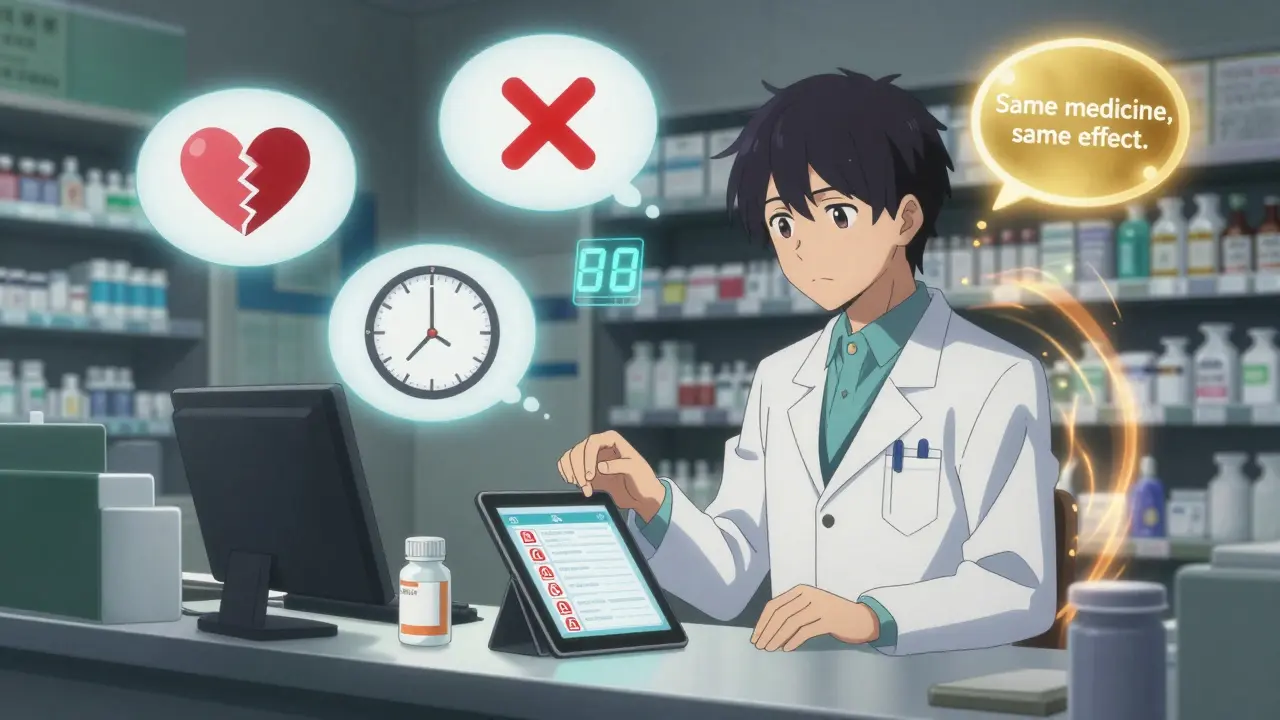
What Patients Really Think
Look at the reviews on Trustpilot. Fifty-seven percent of negative pharmacy reviews mention feeling rushed during generic substitution. Meanwhile, positive reviews often say: "The pharmacist actually explained why the pill looked different. I felt like I could trust it." Patients don’t care that generics save $1,200 a year. They care that they’re not being tricked. They care that someone took the time to make sure they understood. One Reddit user wrote: "My pharmacist showed me pictures of what my generic would look like compared to the brand, and that one minute saved me from throwing away my medication." That’s the power of counseling. It’s not about selling. It’s about saving.Future Trends: More Pressure, More Tools
By 2026, 75% of pharmacies are expected to use AI tools that flag patients likely to have concerns about generics-based on past behavior, age, language, or refill patterns. These tools will suggest personalized talking points. A 72-year-old with heart disease who stopped a generic before? The system will prompt you to emphasize bioequivalence and safety. Medicare Part D is also starting to tie bonus payments to evidence of good generic counseling. That means pharmacies will be scored on how well they educate, not just how fast they fill. But here’s the catch: the American Medical Association warns that documentation demands are growing so fast they’re eating into actual counseling time. That’s why the structured five-point approach matters more than ever. Efficiency isn’t about speed. It’s about clarity.Final Thought: You’re the Last Line of Defense
The prescriber wrote the script. The insurer approved the generic. The manufacturer made the pill. But you’re the one who hands it to the patient-and explains why it’s safe. That’s not a side task. It’s core to your role. Every time you skip the talk, you risk a patient going off their meds. Every time you do it right, you save a life. Don’t wait for them to ask. Don’t wait for the system to remind you. Don’t wait for the law to change. Do it now. Every time. Because someone’s health depends on it.Do I have to counsel every time a generic is dispensed, even for refills?
Yes. Federal law under OBRA ’90 requires counseling every time a prescription is filled or refilled. Even if the patient received counseling before, each refill is a new opportunity to confirm understanding. Patients may forget details, or their concerns may change. The BC Pharmacists Association and ASHP both emphasize that counseling is not a one-time event-it’s an ongoing responsibility.
Can pharmacy technicians provide generic counseling?
No. Only licensed pharmacists can provide counseling. Technicians can inform patients that counseling is available or help with administrative tasks like printing handouts, but they cannot explain bioequivalence, side effects, or answer clinical questions. This is a legal requirement in all 50 states. Violating this can result in fines or license suspension.
What if the patient refuses counseling?
You must still offer it. If the patient declines, document that counseling was offered and refused, along with your assessment of their understanding. For example: "Counseling offered regarding generic substitution. Patient declined, stating they’ve taken this generic before and understand it." If you have reason to believe they don’t understand (e.g., they’ve stopped meds before), you may need to escalate-perhaps by asking them to confirm the drug’s purpose in their own words.
How do I explain bioequivalence to someone without a science background?
Say: "Think of it like two different brands of aspirin. One might be shaped differently or have a coating, but they both contain the same active ingredient-acetylsalicylic acid-and they both work the same way to relieve pain. The FDA tests generics to make sure they deliver the same amount of medicine into your body at the same speed as the brand. It’s not a cheaper version-it’s an identical treatment, just without the brand name." Avoid terms like "bioequivalence" unless they ask.
Are there any generics that aren’t truly equivalent?
All FDA-approved generics must meet strict bioequivalence standards. There are rare exceptions with complex drugs like inhalers or injectables, but these are clearly labeled and rarely substituted without prescriber approval. For the vast majority of pills-blood pressure, cholesterol, diabetes, antidepressants-the generic is just as effective. The FDA has approved over 20,000 generic drugs since 1984, with no evidence of lower effectiveness in real-world use. If a patient has a specific concern about a drug like levothyroxine or warfarin, you may need to consult the prescriber, but the generic is still considered equivalent.
What should I do if a patient says the generic isn’t working?
Don’t dismiss it. Ask: "When did you notice the difference? Did you start taking it at the same time? Are you taking it the same way?" Sometimes, it’s a timing issue, a new interaction, or a change in diet. Other times, the patient may have had a bad experience with a different generic before. Document their concern, offer to contact the prescriber, and consider switching back to brand if clinically appropriate. Never assume the patient is imagining it-non-adherence often starts with a single moment of doubt.

kenneth pillet
January 18, 2026 AT 16:03Wendy Claughton
January 19, 2026 AT 15:04Stacey Marsengill
January 20, 2026 AT 07:20Jay Clarke
January 20, 2026 AT 23:40Jake Moore
January 22, 2026 AT 15:24Praseetha Pn
January 23, 2026 AT 01:25Emma #########
January 23, 2026 AT 23:29christian Espinola
January 25, 2026 AT 14:59Chuck Dickson
January 26, 2026 AT 02:49