Rifampin and Birth Control: Why Your Contraceptive May Fail

Rifampin Contraceptive Interaction Checker
Imagine taking your birth control pill every single day at the same time, never missing a dose, yet still facing a real risk of unexpected pregnancy. For most women, this scenario is nearly impossible. But if you are prescribed Rifampin a potent antibiotic used primarily to treat tuberculosis and other serious bacterial infections, that safety net disappears. Rifampin doesn't just interact with your birth control; it actively dismantles its effectiveness by forcing your liver to metabolize contraceptive hormones at an accelerated rate.
This isn't a theoretical concern based on weak anecdotal evidence. It is a well-documented, clinically significant interaction recognized by major health organizations worldwide. The Centers for Disease Control and Prevention (CDC) classifies Rifampin as a Category 3 drug interaction with combined hormonal contraceptives (CHCs). This classification means the proven risks generally outweigh the advantages of using these contraceptives during concurrent therapy. If you are starting treatment for tuberculosis or certain other infections involving Rifampin, understanding this mechanism is not just helpful-it is essential for preventing unintended pregnancy.
The Mechanism: How Rifampin Neutralizes Hormonal Contraceptives
To understand why Rifampin causes breakthrough ovulation the release of an egg from the ovary despite being on hormonal birth control, we need to look at what happens inside your liver. Most hormonal contraceptives work by maintaining steady levels of estrogen and progestin in your blood to suppress the hormonal signals that trigger ovulation. Normally, your liver processes these hormones at a predictable rate.
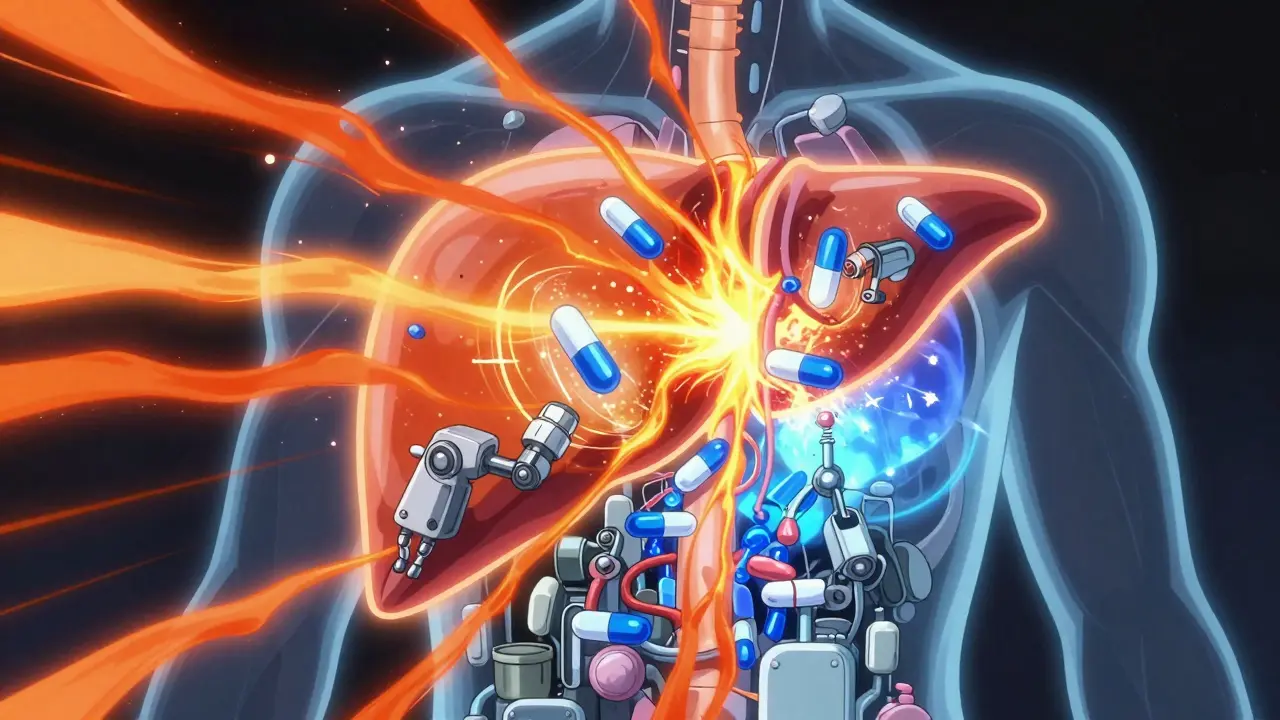
Rifampin acts as a powerful inducer of hepatic cytochrome P450 enzymes, specifically the CYP3A4 enzyme system. Think of these enzymes as workers on an assembly line. When Rifampin enters your system, it essentially hires hundreds of new workers and turns up the speed of the assembly line. As a result, your liver breaks down estrogen and progestin much faster than usual.
A 2024 systematic review published in the National Institutes of Health (NIH) archives provides stark numbers illustrating this effect. The study found that when combined oral contraceptives (COCs) were taken with Rifampin, progestin exposure-measured by the area under the curve (AUC)-dropped by 30% to 83%. Ethinyl estradiol exposure fell by 42% to 66%. In simpler terms, your body clears out the active ingredients so quickly that they cannot maintain the threshold needed to stop ovulation. This metabolic acceleration increases estrogen metabolism fourfold, leaving hormone levels too low to prevent the release of an egg.
Rifampin vs. Other Antibiotics: A Critical Distinction
There is a widespread myth that all antibiotics reduce the effectiveness of birth control pills. This misconception leads many women to unnecessarily use backup contraception for minor infections like earaches or urinary tract infections. However, the science tells a different story. Rifampin is unique among commonly prescribed antibiotics.
| Antibiotic Class | Enzyme Induction? | Contraceptive Failure Risk | CDC Recommendation |
|---|---|---|---|
| Rifampin | Strong Inducer | High (Documented Ovulation) | Use Backup Method |
| Rifabutin | Moderate Inducer | Moderate/Low | Consider Backup |
| Amoxicillin | No | Negligible | No Backup Needed |
| Azithromycin | No | Negligible | No Backup Needed |
| Doxycycline | No | Negligible | No Backup Needed |
The American Academy of Family Physicians explicitly states that Rifampin is the only antibiotic with well-documented evidence of reducing hormonal contraceptive effectiveness through enzyme induction. A 2018 systematic review by the OBG Project analyzed studies combining hormonal contraceptives with non-rifamycin antibiotics and found "no observed differences in ovulation suppression or breakthrough bleeding." While some older guidelines listed drugs like tetracycline or erythromycin as risky, modern data does not support this. The Journal of the Society of Obstetricians and Gynaecologists of Canada notes clearly: "When taking Rifampin, oral contraceptives cannot be relied upon for contraception." This distinction is vital because it helps clinicians and patients avoid unnecessary anxiety over common prescriptions while remaining vigilant about Rifampin.
Real-World Risks and Clinical Evidence
The gap between pharmacokinetic data and actual pregnancy outcomes can sometimes feel abstract, but clinical history paints a clear picture. This interaction was first documented in the 1970s, leading the World Health Organization (WHO) to issue warnings in 1988 that remain relevant today. The United Kingdom's Committee on Safety of Medicines recorded 150 case reports of contraceptive failure associated with antibiotic use between 1970 and 1999, with Rifampin being a primary suspect in many instances.
Recent user experiences reinforce these historical findings. On medical forums, patients report pregnancies despite perfect adherence to their pill schedules while undergoing tuberculosis treatment. One survivor shared that her OB/GYN confirmed the Rifampin interaction as the likely cause of her pregnancy, even though she took Ortho Tri-Cyclen consistently. These aren't isolated anomalies; they are expected outcomes of the biological mechanism described above. The typical failure rate of oral contraceptives is around 0.3% with perfect use. With Rifampin co-administration, that risk skyrockets, though exact percentages vary based on individual metabolism and the specific contraceptive formulation used.
Managing the Risk: Practical Strategies
If you require Rifampin therapy, you do not have to stop your current contraceptive method immediately, but you must add protection. The CDC recommends using a backup contraceptive method, such as condoms, for the entire duration of Rifampin therapy and for 28 days after discontinuation. This extra month is crucial because the enzyme-inducing effects of Rifampin persist even after the last dose is taken. Your liver needs time to return to its baseline processing speed.
For those seeking more robust protection, alternative methods that are not affected by liver enzymes are ideal choices. The Contraception and Sexual Health (COSRH) organization suggests considering:
- Copper IUD a non-hormonal intrauterine device that prevents fertilization
- Progestin-only implants such as Nexplanon, which may be less susceptible to enzyme induction, though caution is still advised
- Barrier methods (condoms, diaphragms)
Some clinicians historically recommended switching to higher-dose estrogen contraceptives (containing 50 mcg ethinyl estradiol) to counteract the increased metabolism. However, there is limited evidence that this strategy fully compensates for the dramatic reduction in hormone levels caused by Rifampin. Relying solely on a higher dose without backup protection is risky. The most conservative and effective approach remains adding a non-hormonal barrier method or switching to an IUD.

What About Rifabutin and Other Rifamycins?
Rifampin is part of a broader class of drugs called rifamycins, which includes Rifabutin an antibiotic often used for tuberculosis in HIV-positive patients or those who cannot tolerate Rifampin. Rifabutin also induces liver enzymes, but its effect is significantly weaker than that of Rifampin. Studies show no detected ovulation in serum progesterone tests when COCs were combined with Rifabutin, and pharmacokinetic changes are generally smaller. The NIH systematic review concludes that while Rifampin poses a high risk, Rifabutin presents a lesser, though still present, risk. Therefore, caution and potentially backup contraception are still recommended for Rifabutin users, but the urgency is lower compared to Rifampin.
Frequently Asked Questions
Does Rifampin affect all types of birth control?
Rifampin significantly reduces the effectiveness of hormonal contraceptives, including combined oral contraceptives (pills), patches, vaginal rings, and potentially progestin-only pills. It does not affect non-hormonal methods like copper IUDs or barrier methods (condoms). Depot medroxyprogesterone acetate (Depo-Provera) injections may also be compromised, though data is less extensive than for oral pills.
How long should I use backup contraception after stopping Rifampin?
You should continue using backup contraception for 28 days after your last dose of Rifampin. This allows your liver enzymes to return to normal levels and ensures that your hormonal contraceptive can effectively suppress ovulation again.
Can I take my birth control pill at a different time to avoid the interaction?
No. Timing your pill intake relative to your Rifampin dose will not prevent the interaction. Rifampin permanently alters the structure and activity of liver enzymes for weeks, meaning it accelerates hormone metabolism regardless of when you take your pill. Consistent timing is important for general efficacy, but it does not counteract Rifampin's enzyme-inducing effects.
Is Rifabutin safe to take with hormonal birth control?
Rifabutin has a weaker enzyme-inducing effect than Rifampin, but it can still reduce contraceptive effectiveness. While the risk is lower, experts recommend using backup contraception or choosing a non-hormonal method to be safe. Consult your healthcare provider for personalized advice.
Why don't other antibiotics like Amoxicillin interfere with birth control?
Most common antibiotics, such as Amoxicillin, Azithromycin, and Doxycycline, do not induce liver enzymes responsible for metabolizing contraceptive hormones. They may cause gastrointestinal upset (like diarrhea or vomiting), which could prevent absorption if you vomit shortly after taking the pill, but they do not chemically break down the hormones faster. Rifampin is unique in its ability to dramatically increase the metabolic clearance of these hormones.
Should I switch to a higher-dose birth control pill while on Rifampin?
While some clinicians suggest higher-dose estrogen pills (50 mcg ethinyl estradiol), there is insufficient evidence that this fully compensates for the rapid metabolism caused by Rifampin. The safest approach is to use a backup method like condoms or switch to a non-hormonal IUD rather than relying on a higher dose alone.
Nisha Koshti
May 11, 2026 AT 23:18hmm... interesting read.. but why do they always hide the real side effects?? :o i bet the pharma companies know exactly what this does and dont care about us little people taking our pills every day without knowing the truth!!! :(((( the government is lying to us about safe contraception methods!! :(
Jannet Suen
May 13, 2026 AT 01:45I appreciate the detailed breakdown here, but let's keep things respectful and factual. While it's easy to jump to conspiracy theories, the science behind cytochrome P450 induction is well-documented and peer-reviewed. It's not about hiding truths; it's about understanding complex pharmacology. We should focus on empowering ourselves with accurate medical information rather than fueling unnecessary paranoia. That said, the point about backup contraception is valid and crucial for patient safety. Let's encourage open dialogue without resorting to distrustful narratives that can hinder actual health outcomes. Everyone deserves access to clear, evidence-based guidance.
Claire A
May 13, 2026 AT 23:27Great post! It really helps to have such clear explanations about how these interactions work. I've seen so many friends get confused by conflicting advice online, so having a reliable source like this is a huge relief. Keep up the good work spreading awareness!
andrew iregbayen
May 14, 2026 AT 12:36Hey there, this is some solid info right here. I was curious about whether timing matters at all, and glad to see it doesn't help much against the enzyme boost. Makes me wonder if there are other drugs that do similar things though? Anyway, good job explaining the mechanism clearly without getting too bogged down in jargon.
Laura ciotoli
May 15, 2026 AT 13:46You are mistaken about several key points. Rifampin is indeed the primary concern, but ignoring the potential impact on progestin-only implants entirely is negligent. Furthermore, suggesting higher dose estrogen is 'risky' ignores clinical protocols where it is sometimes used under strict supervision. Your simplification of complex medical guidelines is dangerous and misleading. Do not rely on internet forums for critical healthcare decisions. Consult a licensed physician immediately.
Sarah O'Donnell
May 16, 2026 AT 16:29Ugh, typical bad advice from who-knows-who 😒. You guys really think you know better than doctors? 🙄 My friend took rifampin and got pregnant despite using condoms AND the pill because she trusted some random blog post instead of listening to her specialist. Now she's blaming everyone but herself. Such drama. 🤷♀️ Just follow the rules and stop making excuses for poor planning. #StaySafe #NoExcuses
Amelia Vaughan
May 16, 2026 AT 17:29Stop whining. Take responsibility. If you're smart enough to take birth control daily, you're smart enough to ask your doctor about interactions. Don't blame the medicine. Blame your lack of preparation. Simple logic fails you.
Kevin S
May 17, 2026 AT 13:36Hey everyone! 👋 Just wanted to say thanks for sharing this. It’s super helpful to know that not all antibiotics mess with birth control. I’ve been worried about every prescription I get. 😅 Gotta love learning something new today! 💪
Madison Jones
May 17, 2026 AT 22:23This is incredibly useful information!! I never realized that the backup method needs to continue for 28 days after stopping the medication!! That extra month is so important!! Thank you for highlighting this detail!! Many people probably stop the backup too early!! Please share this widely!!
Sarah Grenberg
May 19, 2026 AT 10:47It is imperative that we recognize the severity of this interaction. The distinction between rifampin and other antibiotics cannot be overstated. Patients must be vigilant. Healthcare providers must communicate clearly. There is no room for ambiguity when reproductive health is at stake. We must demand better education and clearer labeling. Silence is complicity. Action is required. Now.
Brian Lee
May 21, 2026 AT 01:07Good article. I think the table comparing different antibiotics was very helpful. It clears up a lot of confusion. I hope more people read this. It is important to know the facts. Keep writing good content.
Jake Williams
May 22, 2026 AT 10:06Oh great, another reason to hate modern medicine. Why can't we just have simple solutions? Everything has a catch now. First it's side effects, then it's interactions, then it's costs. Typical bureaucratic nonsense designed to confuse the average person into compliance. Just give us straight answers without the scientific fluff. And don't pretend this isn't a failure of the system.
Nilesh Mandani
May 23, 2026 AT 08:06Interesting perspective on the biological mechanisms involved. It raises questions about how our bodies adapt to external stimuli. The concept of enzyme induction is fascinating from a philosophical standpoint too - how one substance can fundamentally alter the processing of another. Perhaps we should look at this as a reminder of the interconnectedness of all biological systems. Small changes can have large ripple effects.
Guy Birtwhistle
May 23, 2026 AT 12:40Look, I'm not here to argue semantics. The bottom line is: if you're on rifampin, use a condom. Period. No debate. No exceptions. Stop looking for loopholes in the science and just protect yourself. It's not rocket science. It's basic self-preservation. End of story.