Ephedrine and MAO Inhibitors: Why This Mix Triggers a Hypertensive Crisis
MAOI & Ephedrine Interaction Risk Checker
Use this tool to understand the potential risks of combining Monoamine Oxidase Inhibitors (MAOIs) with sympathomimetic agents like ephedrine, pseudoephedrine, or certain foods. This is for educational purposes only and does not replace professional medical advice.
Imagine taking a simple over-the-counter cold pill to clear your sinuses, only to feel your head pound as if it were about to explode. Your vision goes white, your heart hammers against your ribs, and you can’t catch your breath. For most people, this is a nightmare scenario that never happens. But for those taking Monoamine Oxidase Inhibitors, or MAOIs-a class of older antidepressants-this isn't just a bad dream. It is a well-documented medical emergency known as a hypertensive crisis.
The combination of ephedrine and MAOIs is one of the most dangerous drug interactions in pharmacology. It doesn't require high doses to trigger a disaster. Even a small amount of ephedrine, often found in decongestants or weight-loss supplements, can cause blood pressure to skyrocket to levels exceeding 200 mmHg systolic within minutes. This surge can lead to stroke, hemorrhage, or death. Understanding why this happens, how to avoid it, and what to do if it occurs is critical for anyone prescribed these powerful medications.
How the Interaction Works: The Chemical Storm
To understand the danger, we have to look at what these drugs actually do inside your body. Monoamine oxidase (MAO) is an enzyme that acts like a cleanup crew. Its job is to break down neurotransmitters like norepinephrine, serotonin, and dopamine after they’ve done their work. When you take an MAOI, such as phenelzine (Nardil) or tranylcypromine (Parnate), you are essentially shutting down this cleanup crew. The goal is to keep more neurotransmitters available to improve mood, which helps treat depression.
Ephedrine, on the other hand, is a sympathomimetic amine. Think of it as a stimulant that tells your body to release more norepinephrine-the chemical responsible for the "fight or flight" response. Normally, if you took ephedrine, your MAO enzymes would quickly break down the excess norepinephrine to keep your blood pressure stable. But when you are on an MAOI, those enzymes are blocked. The norepinephrine released by the ephedrine has nowhere to go. It accumulates rapidly in your synaptic clefts, flooding your system.
This creates a synergistic effect. The ephedrine pushes the gas pedal, and the MAOI cuts the brakes. The result is a massive, uncontrolled surge in catecholamines. This causes your blood vessels to constrict violently, leading to a rapid spike in blood pressure. This mechanism was first highlighted in a seminal 1965 case report by Dr. M.S. Hirsch, who described a patient who suffered a subarachnoid hemorrhage after taking just a single dose of ephedrine while on an MAOI. That same basic chemistry still applies today.
Recognizing the Signs of a Hypertensive Crisis
A hypertensive crisis triggered by this interaction usually strikes fast. Symptoms typically appear within 30 to 120 minutes after ingesting the offending substance. You need to know what to look for because every minute counts.
- Severe Headache: Often described as occipital (at the back of the head) and radiating forward. Patients frequently describe it as the "worst headache of their life."
- Neck Stiffness: A classic sign of increased intracranial pressure.
- Visual Changes: Blurred vision, seeing spots, or vision going completely white.
- Palpitations and Chest Pain: Your heart races, skips beats, or feels like it’s pounding out of your chest.
- Nausea and Vomiting: Common responses to sudden, extreme physiological stress.
- Sweating and Dilated Pupils: Signs of sympathetic nervous system overload.
If you experience these symptoms after taking any new medication or supplement while on an MAOI, assume it is a hypertensive crisis until proven otherwise. Do not wait to see if it passes. Call emergency services immediately.
Hidden Sources of Ephedrine and Sympathomimetics
The biggest risk isn't usually intentional misuse; it's accidental exposure. Many people don't realize that ephedrine or similar compounds hide in everyday products. Because MAOIs block the metabolism of tyramine and other pressor amines, even indirect sources can be dangerous.
| Product Type | Active Ingredient to Avoid | Why It’s Dangerous |
|---|---|---|
| Cold and Flu Remedies | Ephedrine, Pseudoephedrine, Phenylephrine | Directly stimulates norepinephrine release, causing immediate BP spikes. |
| Weight Loss Supplements | Ephedra (Ma Huang), Synephrine | Often contains high doses of sympathomimetics; banned in some forms but still found online. |
| Asthma Inhalers | Epinephrine, Albuterol (in high doses) | Stimulates adrenergic receptors; use requires strict doctor supervision. |
| Local Anesthetics | Lidocaine with Epinephrine | Dental procedures can introduce epinephrine directly into tissues, triggering crisis. |
| Aged Foods | Tyramine | While not ephedrine, tyramine displaces norepinephrine similarly; aged cheeses, cured meats, and fermented foods pose risks. |
It is crucial to read labels carefully. Even "natural" remedies can contain ephedra alkaloids. If you are unsure, ask your pharmacist. They can check for hidden sympathomimetics that might not be listed prominently on the front of the box.
Not All MAOIs Are Equal: Risk Levels
While the general rule is to avoid ephedrine entirely, the level of risk depends on the specific type of MAOI you are taking. There are two main categories: irreversible and reversible inhibitors.
Irreversible MAOIs include phenelzine, tranylcypromine, and isocarboxazid. These drugs permanently bind to the monoamine oxidase enzyme. Your body has to create new enzymes to recover, which takes time. This means the risk persists for 2 to 3 weeks after you stop taking the medication. With these drugs, even tiny amounts of ephedrine (as low as 12.5 mg) can trigger a crisis. This is why the FDA maintains a black box warning for all these medications.
Reversible MAOIs, like moclobemide, work differently. They bind temporarily to the enzyme. Once the drug clears your system, the enzyme functions again. This usually happens within 24 to 48 hours. While still risky, the threshold for triggering a crisis is higher. You would generally need a much larger dose of tyramine or sympathomimetics to cause harm compared to irreversible MAOIs.
Then there is selegiline (Emsam), a transdermal patch. At lower doses (6 mg/24hr), it selectively inhibits MAO-B in the brain, sparing the MAO-A in the gut and liver that handles dietary tyramine. This significantly reduces the risk of food-induced crises. However, at higher doses (12 mg or 18 mg), it loses selectivity and carries the same risks as oral MAOIs. Furthermore, selegiline metabolizes into amphetamine-like compounds, so adding external ephedrine is still dangerous.
Emergency Management: What Doctors Do
If you end up in the emergency room with a hypertensive crisis from this interaction, the treatment protocol is specific and urgent. Standard treatments for high blood pressure might not work-or could make things worse.
The gold standard treatment is intravenous phentolamine. Phentolamine is an alpha-adrenergic blocker. It works by relaxing the blood vessels that have been constricted by the flood of norepinephrine. Typical doses range from 5 to 15 mg IV. It acts quickly to bring blood pressure down without causing a dangerous rebound effect.
Crucially, doctors must avoid certain common blood pressure medications. Sublingual nifedipine, for example, is absolutely contraindicated. It can cause blood pressure to drop too precipitously, leading to reduced blood flow to the brain and potentially causing a stroke. Beta-blockers alone are also avoided initially because blocking beta-receptors without blocking alpha-receptors can leave the vasoconstriction unchecked, worsening the hypertension.
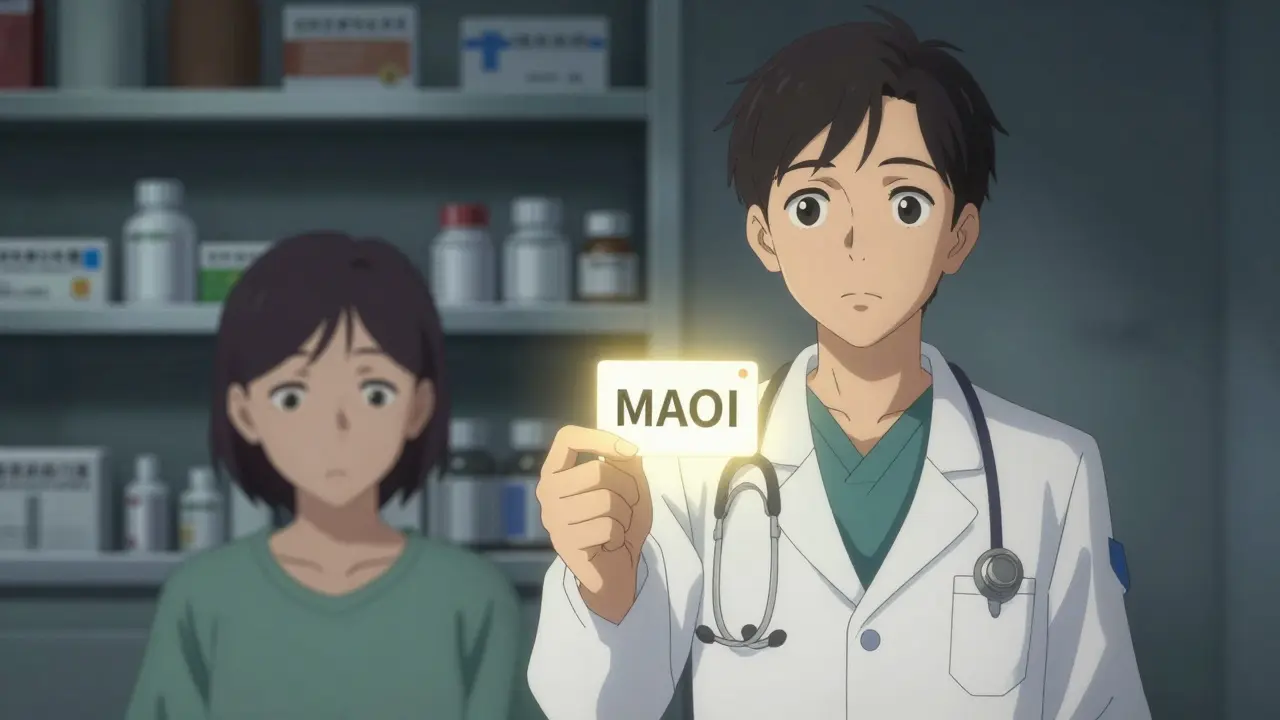
Prevention is far easier than cure. Experts recommend carrying an "MAOI alert card" at all times. Studies show that patients who carry these cards are significantly less likely to accidentally take contraindicated medications. The card lists all drugs to avoid, including ephedrine, pseudoephedrine, and certain antibiotics. It serves as a quick reference for pharmacists and doctors during emergencies.
The Washout Period: Timing Is Everything
One of the most misunderstood aspects of MAOI therapy is the washout period. You cannot simply stop an MAOI and start taking ephedrine-containing cold meds the next day. Nor can you switch from another antidepressant to an MAOI without waiting.
For irreversible MAOIs, you must wait at least 14 days after stopping the MAOI before taking any sympathomimetic agent like ephedrine. This allows your body enough time to regenerate sufficient monoamine oxidase enzyme activity. Conversely, if you are switching from an SSRI or SNRI to an MAOI, you usually need to wait 5 weeks (for fluoxetine) or 2 weeks (for others) to avoid serotonin syndrome, a different but equally dangerous condition.
For reversible MAOIs like moclobemide, the washout period is shorter-typically 24 to 48 hours. However, individual metabolism varies, so always consult your prescriber for personalized timing.
Future Directions and Safer Alternatives
Despite the risks, MAOIs remain vital tools for treating treatment-resistant depression and atypical depression. About 500,000 Americans are currently prescribed them. Researchers are actively working to mitigate these risks. Newer agents like befloxatone, approved recently in some regions, offer reversible inhibition with a short half-life, drastically reducing the window of vulnerability.
Pharmacogenetic testing is also emerging as a way to identify patients who might tolerate MAOIs better or who are at higher risk for adverse reactions. While not yet standard practice, this could personalize safety protocols in the future. Until then, strict adherence to avoidance guidelines remains the only surefire way to stay safe.
Can I take Sudafed if I am on Nardil?
No. Sudafed contains pseudoephedrine, which is chemically similar to ephedrine and acts as a sympathomimetic. Taking it with Nardil (phenelzine) can trigger a hypertensive crisis. You should avoid all decongestants containing pseudoephedrine, phenylephrine, or ephedrine while on Nardil and for 14 days after stopping it.
How long does the risk last after stopping an MAOI?
For irreversible MAOIs like phenelzine and tranylcypromine, the risk lasts for approximately 2 to 3 weeks after your last dose. This is because your body needs time to produce new monoamine oxidase enzymes. For reversible MAOIs like moclobemide, the risk subsides within 24 to 48 hours.
What should I do if I accidentally take ephedrine while on an MAOI?
Seek emergency medical attention immediately. Do not wait for symptoms to appear. Tell the medical staff exactly what you took and when. Monitor yourself closely for severe headaches, neck stiffness, palpitations, or visual changes, which are signs of a hypertensive crisis.
Are there any safe decongestants for MAOI users?
Most oral decongestants are unsafe. Saline nasal sprays and steam inhalation are non-drug alternatives that are generally safe. Always consult your doctor or pharmacist before using any over-the-counter medication, including antihistamines, as some combinations can still be problematic.
Does Emsam (selegiline patch) have the same risk?
At the lowest dose (6 mg/24hr), Emsam has a significantly lower risk of dietary and drug interactions because it selectively inhibits MAO-B in the brain. However, at higher doses (12 mg or 18 mg), it inhibits MAO-A as well, and the risk of hypertensive crisis with ephedrine returns to levels similar to oral MAOIs. Caution is still advised.