What Is an ANDA? The Complete Guide to Abbreviated New Drug Applications and FDA Approval

Every time you pick up a generic pill at the pharmacy-say, a $4 version of a brand-name blood pressure med-you’re benefiting from something called an ANDA. But what exactly is an ANDA? It’s not just a form. It’s the legal and scientific pathway that lets generic drug makers get FDA approval without repeating every single clinical trial ever done on the original drug. And it’s one of the biggest reasons prescription drugs in the U.S. cost a fraction of what they used to.
What Does ANDA Stand For, and Why Does It Matter?
ANDA stands for Abbreviated New Drug Application. It’s the official submission a company makes to the U.S. Food and Drug Administration (FDA) to get permission to sell a generic version of a brand-name drug. The word “abbreviated” is key here. Unlike the original drug maker, who had to prove safety and effectiveness from scratch using years of animal and human studies, the generic company doesn’t need to start over. They can rely on the FDA’s previous findings about the original drug-called the Reference Listed Drug, or RLD.
This system was created by the Hatch-Waxman Act of 1984. Before that, generic drugs faced huge legal and scientific barriers. Brand-name companies held patents for years, and even after those expired, no one could easily bring a copy to market. The Hatch-Waxman Act changed all that. It gave generic manufacturers a clear, faster, cheaper way to enter the market. Today, over 90% of all prescriptions in the U.S. are filled with generic drugs approved through the ANDA pathway.
How Does an ANDA Prove a Generic Drug Is Safe and Effective?
It’s not enough to say, “It looks the same.” The FDA requires proof that the generic drug works the same way in your body as the brand-name version. That’s where two critical tests come in: pharmaceutical equivalence and bioequivalence.
Pharmaceutical equivalence means the generic has the same active ingredient, strength, dosage form (like tablet or injection), and route of administration (oral, topical, etc.) as the original. It also has to meet the same quality standards-no extra fillers or impurities that could cause harm.
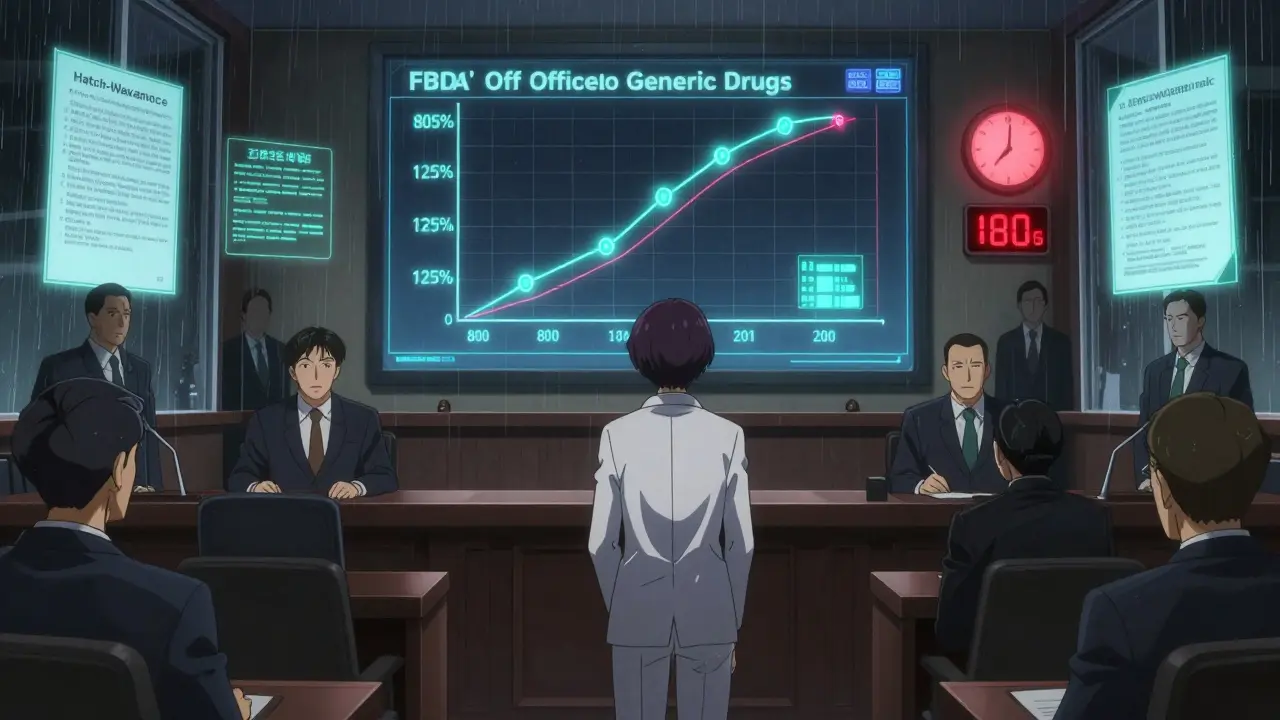
Bioequivalence is the real test. It’s done with 24 to 36 healthy volunteers who take both the brand-name drug and the generic version, usually in separate study periods. Blood samples are taken over time to measure how much of the drug enters the bloodstream and how fast. The FDA requires that the generic’s absorption rate and total exposure fall within 80% to 125% of the brand-name drug’s numbers. That’s called the 80-125% confidence interval for AUC (area under the curve) and Cmax (peak concentration). If it passes, the FDA says: “This generic is therapeutically equivalent.”
And it’s not just about the active ingredient. The generic must also have the same labeling-dosage instructions, warnings, side effects-as the original. The only things that can be different? The name, color, shape, and inactive ingredients (like dyes or preservatives), as long as those don’t affect how the drug works.
ANDA vs. NDA: The Big Difference
Every new drug starts with a New Drug Application (NDA). That’s what Pfizer, Merck, or Roche files when they invent a brand-new medicine. An NDA can take 10 to 15 years and cost over $2 billion to develop. It includes everything: chemistry, manufacturing, animal studies, Phase I, II, and III clinical trials with thousands of patients.
An ANDA? It’s a completely different beast. It doesn’t need any new clinical trials. The generic company just needs to prove equivalence. That cuts development time to 3-4 years and costs between $1 million and $5 million. The FDA’s review clock is also faster: 10 months for a standard ANDA under the Generic Drug User Fee Amendments (GDUFA). For an NDA? Twelve months, even if it’s priority.
This speed and cost difference is why generics exist. Without the ANDA pathway, most people couldn’t afford their meds. A brand-name drug like Eliquis might cost $500 a month. The generic? Around $10. That’s not luck. That’s the ANDA system working.
What Happens After an ANDA Is Submitted?
Submitting an ANDA isn’t just filling out a form. It’s a complex, highly technical process. The application includes:
- Detailed chemistry and manufacturing data-how the drug is made, purified, and tested
- Stability studies showing the drug won’t break down over time
- Bioequivalence study results
- Proposed labeling, identical to the brand except for the name
- Patent certifications under Hatch-Waxman-this is critical
The patent part is tricky. The FDA’s Orange Book lists every patent tied to the brand-name drug. The generic company must certify for each one: either the patent has expired, it’s invalid, or they’re not infringing. If they challenge a patent and the brand-name company sues, the FDA can delay approval for up to 30 months. That’s why some generics wait years to launch-even after the patent expires.
There’s also a financial incentive: the first company to file an ANDA challenging a patent gets 180 days of exclusive rights to sell their version. That’s why companies race to be first. In 2023, 12 generic versions of Humira hit the market on the same day because of this rule.
Who Approves ANDAs, and How Long Does It Take?
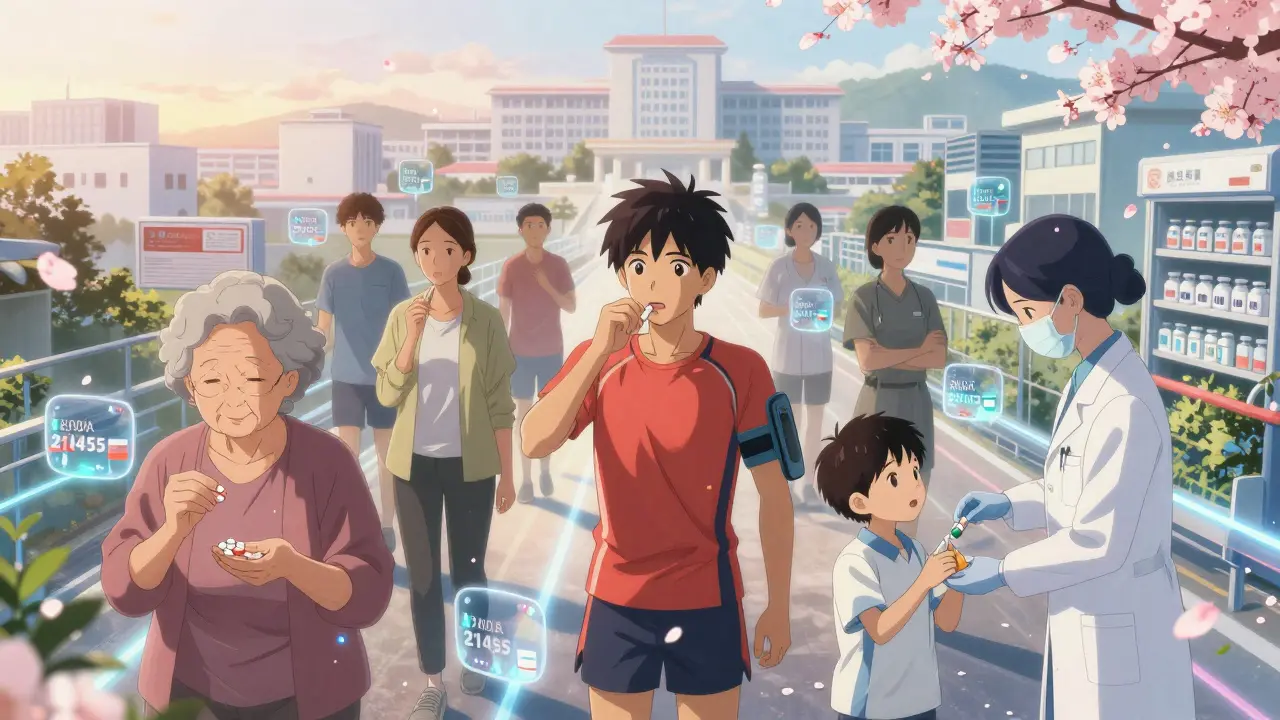
The FDA’s Center for Drug Evaluation and Research (CDER), specifically its Office of Generic Drugs (OGD), handles all ANDAs. As of 2023, they’ve approved over 11,000 generic drugs through this process. Each approved ANDA gets a six-digit number-like ANDA 214,455 for the generic version of Eliquis.
Approval rates have improved. In 2023, about 65% of ANDAs got approved on the first try. The FDA’s GDUFA IV goals aim to push that to 90% by 2027. That’s a big deal because every delay means patients wait longer for affordable meds.
But it’s not perfect. The most common reasons ANDAs get rejected? Inadequate manufacturing controls (32% of cases) and incomplete bioequivalence data (27%). Smaller generic companies often struggle with these requirements. One survey found that 68% of smaller firms got at least two “complete response letters” from the FDA before approval-meaning they had to resubmit with fixes.
Who Benefits from ANDAs?
The numbers speak for themselves. Generic drugs save the U.S. healthcare system about $313 billion every year. Over the past decade, they’ve saved over $2.2 trillion. That’s not just corporate profit-it’s real money back in patients’ pockets, insurance funds, and government programs like Medicare.
Generic drugs make up 90% of prescriptions but only 23% of total drug spending. That’s the power of competition. When a generic enters the market, the brand-name drug’s price often drops by 80-85% within a year. That’s not speculation-it’s data from Harvard Medical School and the FDA.
Patients with chronic conditions-diabetes, high cholesterol, asthma, depression-rely on generics daily. Without the ANDA system, many couldn’t afford to stay on their meds. The result? More hospitalizations, worse outcomes, higher overall costs.
Limitations and Challenges
Not every drug can go generic through an ANDA. Complex products-like inhalers, topical creams, or injectables with special delivery systems-are harder to copy. Why? Because bioequivalence isn’t as easy to measure. For example, with an inhaler, you can’t just check blood levels. You have to prove the drug reaches the lungs the same way. The FDA has started special programs for these, but approval still takes longer.
Another issue? Manufacturing. Over 80% of generic drug ingredients come from just two countries: India and China. That creates supply chain risks. If a factory shuts down due to quality issues-or a natural disaster, or political tension-there can be drug shortages. Experts warn this over-reliance is a hidden vulnerability.
And while the system works well for small-molecule drugs, it doesn’t apply to biologics-like insulin or cancer drugs made from living cells. Those follow a different pathway called biosimilars, which is even more complex and expensive.
The Future of ANDAs
The ANDA pathway isn’t slowing down. Analysts predict complex generics will make up 25% of the market by 2028, up from 15% today. That means more innovation in how generics are developed, tested, and approved.
The FDA is also pushing for more transparency. All ANDA submissions are now required to be electronic through the eCTD system. That’s cut administrative errors by 60%. Companies with dedicated regulatory teams have a 42% first-cycle approval rate-nearly double those without.
What’s next? More support for small manufacturers. Better guidance on complex products. And continued pressure to keep prices low. The Congressional Budget Office projects generic drugs will save $1.7 trillion between 2024 and 2033. That’s not a guess. It’s a forecast based on current trends.
The ANDA system isn’t perfect. But it’s one of the most successful public health policies in modern history. It balances innovation with access. It lets companies compete without reinventing the wheel. And it puts affordable medicine in the hands of millions.
Is an ANDA the same as a generic drug?
No. An ANDA is the application a company submits to the FDA to get approval to sell a generic drug. The generic drug is the actual medicine you take. The ANDA is the paperwork that proves it’s safe, effective, and equivalent to the brand-name version.
Can any company file an ANDA?
Any company can file, but it’s not easy. They need expertise in pharmaceutical chemistry, manufacturing, bioequivalence testing, and FDA regulations. Most successful filers have dedicated regulatory affairs teams. Smaller companies often partner with contract research organizations to handle the technical work.
Do generic drugs work as well as brand-name drugs?
Yes. The FDA requires that generic drugs meet the same strict standards for quality, strength, purity, and performance as brand-name drugs. Studies show 97% of generics are therapeutically equivalent. Millions of patients use generics every day without any difference in results.
Why are generic drugs cheaper?
Because they don’t have to pay for the original research, clinical trials, or marketing. The ANDA pathway lets them use existing safety and efficacy data. That cuts development costs from billions to millions. Plus, once multiple generics enter the market, competition drives prices down further.
How long does it take to get an ANDA approved?
The FDA’s goal is to review a standard ANDA in 10 months. But delays happen-especially if the application is incomplete or if there’s patent litigation. On average, from submission to approval, it takes 12 to 24 months, depending on complexity and whether the company has experience with ANDAs.
Are all generic drugs approved through ANDAs?
Almost all. Over 98% of generic drugs in the U.S. enter the market via the ANDA pathway. The exceptions are complex biologics, which follow a different system called biosimilars under the BPCIA. ANDAs are for small-molecule drugs only.
What’s Next for Generic Drugs?
If you’re a patient, keep taking your generics. They’re safe, effective, and saving you money. If you’re in the industry, the path is clearer than ever-better guidance, faster reviews, and more support for complex products. The ANDA system isn’t going away. It’s evolving. And as long as people need affordable medicine, it will keep working.

Adewumi Gbotemi
January 12, 2026 AT 09:14So basically, if a pill looks different but has the same stuff inside, and your body absorbs it the same way, it's good to go? That's wild. I always thought generics were cheap because they were low quality. Glad I was wrong.
Alfred Schmidt
January 12, 2026 AT 11:02Are you kidding me? This is why America is falling apart-people think ‘same active ingredient’ means ‘same drug.’ I’ve seen patients crash after switching to generics-heart arrhythmias, seizures, you name it. The FDA’s 80-125% range? That’s a fucking buffet for side effects! Where’s the accountability?!
Priscilla Kraft
January 13, 2026 AT 10:05Wow, this was so well explained! 🙌 I used to be scared of generics too, but now I get it-bioequivalence isn’t just marketing, it’s science. My dad’s been on generic metformin for 8 years and his A1c is better than ever. Thank you for breaking this down! 💊❤️
Vincent Clarizio
January 14, 2026 AT 05:21Let’s be real-this whole ANDA system is a beautiful, tragic paradox of capitalism. On one hand, it democratizes medicine, liberating millions from financial ruin. On the other, it turns life-saving drugs into commodities, stripped of their sacredness, reduced to chemical equivalence, and auctioned off to the lowest bidder. The FDA doesn’t approve drugs-they approve paperwork. And we call this progress? We’ve optimized access at the cost of reverence. The pill doesn’t care if it’s branded or generic-it only cares if it enters your bloodstream. But what about the soul of healing? Where’s the ritual? The trust? The human connection? We’ve outsourced empathy to a 10-month review cycle.
Roshan Joy
January 15, 2026 AT 19:55Interesting read! In India, we call these ‘generic medicines’ too-but the quality varies a lot. Some are great, some are sketchy. It’s good to know the U.S. has strict rules. Still, I wonder how many small labs cut corners. The 32% rejection rate for manufacturing issues? That’s scary.
Michael Patterson
January 17, 2026 AT 13:28Generic drugs work fine unless you're one of the 3% who actually have a reaction. Most people are just paranoid because they don't understand pharmacokinetics. Also, the 180 day exclusivity thing? That's a loophole big enough to drive a truck through. Big pharma lets generics in just to make them fight each other down to pennies. Genius.
Matthew Miller
January 18, 2026 AT 03:5990% of prescriptions are generic? That’s a fucking disaster. You think you’re saving money but you’re just accepting subpar outcomes. I’ve worked in hospitals-patients on generics get more ER visits. The bioequivalence window is a joke. 80-125%? That’s a 45% variance. If your insulin varies that much, you die. This system is a public health time bomb.
Madhav Malhotra
January 18, 2026 AT 19:26Back home in India, we call these ‘copy drugs’-but we’re proud of them! Our manufacturers make 40% of the world’s generics. This ANDA system? It’s like the U.S. finally caught up. We’ve been doing this for decades. Keep it going! 🇮🇳💊
Priya Patel
January 19, 2026 AT 21:51My anxiety med switched to generic last year and I was terrified-but honestly? I didn’t notice a difference. Like, at all. I even forgot which one I was on until I checked the bottle. So… maybe we’re all overthinking this? 😅
Jennifer Littler
January 21, 2026 AT 01:29Pharmaceutical equivalence ≠ therapeutic equivalence. The ANDA pathway relies on surrogate endpoints-bioequivalence metrics that don’t capture real-world variability in metabolism, gut absorption, or drug interactions. The FDA’s approval rate is misleading because it doesn’t account for post-market adverse events. We need pharmacovigilance integration, not just pre-market waivers.
Jason Shriner
January 21, 2026 AT 10:19so like… the government lets companies sell ‘copies’ of drugs… and we call that innovation? 🤡
Sean Feng
January 22, 2026 AT 00:35Generic drugs are fine. Stop overcomplicating it.
Sam Davies
January 22, 2026 AT 05:15Oh, so we’re just outsourcing drug safety to a 10-month bureaucratic checklist? How quaint. I suppose next they’ll let us approve vaccines via QR code and a handshake. At least in Europe, we still believe in the sanctity of the molecule. This is what happens when you let engineers design medicine.
Christian Basel
January 23, 2026 AT 17:55ANDA = regulatory arbitrage. The entire system is designed to circumvent R&D costs. The FDA isn’t approving safety-they’re approving compliance. Real innovation? That’s still locked behind NDA patents. This isn’t progress-it’s cost-shifting.